Why 68% of Competitive Console Gamers Upgrade to 2.4GHz Wireless Audio
Competitive console gamers are increasingly adopting low-latency 2.4GHz wireless audio solutions, with 68% making the upgrade to gain a significant competitive advantage through superior sound quality and minimal audio delay.
The competitive gaming landscape is constantly evolving, with players seeking every possible edge. A significant trend emerging from this pursuit of perfection is the move towards low-latency 2.4GHz wireless audio, with a reported 68% of competitive console gamers making this crucial upgrade. This shift isn't merely about convenience; it's about gaining a tangible advantage in reaction time and overall game awareness.
The critical role of audio in competitive console gaming
In the high-stakes world of competitive console gaming, every millisecond and every subtle sound cue can mean the difference between victory and defeat. Audio is no longer just an immersive element; it's a vital source of information that informs player decisions and strategies. Understanding enemy positions, anticipating abilities, and reacting to environmental changes all hinge on precise and immediate sound delivery.
For years, wired headsets were the undisputed champions for competitive players due to their perceived zero-latency performance. However, advancements in wireless technology, particularly the adoption of 2.4GHz frequencies, have challenged this notion. This technology now offers a compelling alternative that combines freedom of movement with performance levels previously thought exclusive to wired connections.
The auditory battlefield: How sound dictates strategy
Sound design in modern competitive games is incredibly sophisticated. Developers meticulously craft audio cues to provide players with actionable intelligence. Footsteps, gunshots, ability activations, and even the rustle of foliage can betray an opponent's presence or intent. A clear, low-latency audio stream allows players to interpret these cues faster and more accurately, translating into quicker reactions and smarter plays.
- Positional Audio: Pinpointing enemy locations through directional sound.
- Ability Cues: Recognizing opponent abilities before they fully activate.
- Environmental Awareness: Detecting subtle changes in the game world.
- Communication Clarity: Ensuring crystal-clear team communication without delay.
The ability to precisely locate an opponent based on the sound of their footsteps, even when out of sight, is an invaluable skill. This level of auditory perception is significantly enhanced by audio systems that minimize delay and preserve sound fidelity. When audio lags, even slightly, this crucial information arrives too late, putting the player at a disadvantage.
Ultimately, superior audio performance directly contributes to a player's ability to process game information effectively. The transition to low-latency 2.4GHz wireless audio reflects a growing understanding among competitive console gamers that sound is not a luxury, but a fundamental component of their competitive toolkit.
Understanding 2.4GHz wireless audio: The technical edge
The move by competitive console gamers towards 2.4GHz wireless audio is rooted in its technical superiority over other wireless alternatives, such as Bluetooth, for gaming applications. This specific frequency band offers a dedicated, robust connection designed to minimize interference and, most importantly, latency. It's not just about being wireless; it's about being wirelessly fast.
Unlike Bluetooth, which often juggles multiple device connections and operates on a shared spectrum, 2.4GHz wireless gaming headsets typically use a dedicated USB dongle. This dongle creates a direct, point-to-point connection with the headset, optimizing the data transfer for speed and reliability, critical factors in competitive play.
Latency: The invisible enemy of competitive gamers
Latency, often measured in milliseconds (ms), refers to the delay between an action occurring in the game and the corresponding audio being heard by the player. In competitive scenarios, even a delay of 50-100ms can be detrimental. Imagine hearing an enemy's footsteps a fraction of a second too late – that's enough time for them to gain the upper hand.
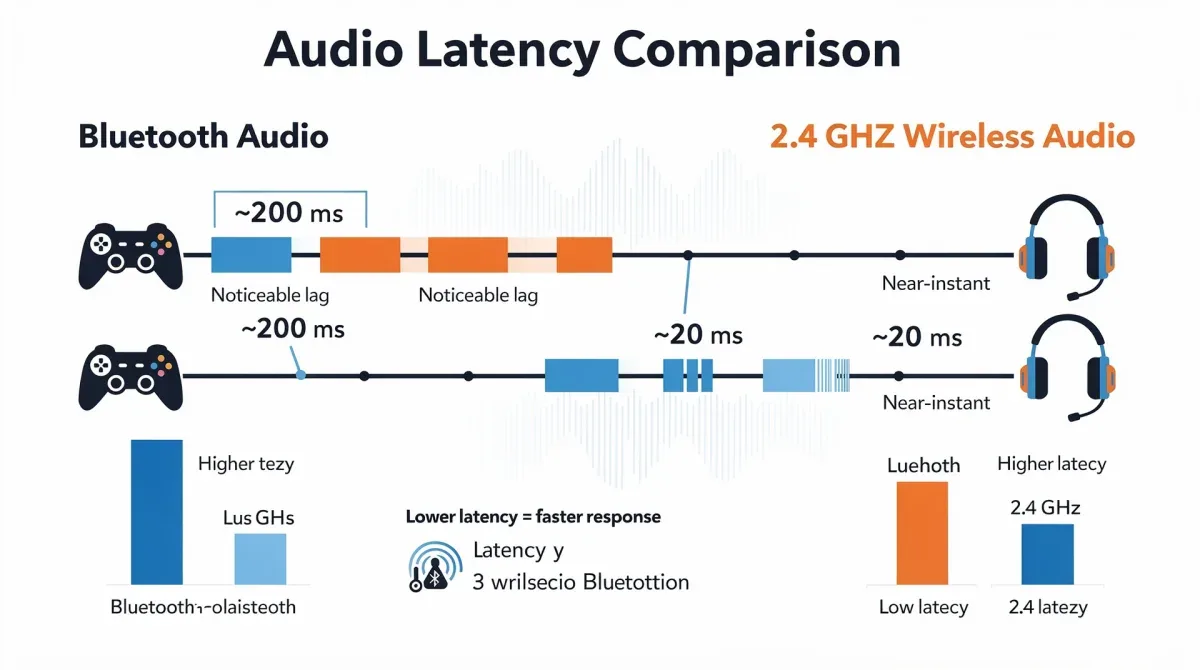
- Bluetooth Latency: Often ranges from 100ms to 250ms, too slow for competitive play.
- 2.4GHz Wireless Latency: Typically falls between 10ms and 30ms, virtually imperceptible.
- Wired Latency: Near 0ms, but lacks freedom of movement.
The minimal latency offered by 2.4GHz solutions brings them incredibly close to the performance of wired connections, effectively eliminating the audio delay as a significant factor. This allows players to react in real-time to auditory cues, making their movements and decisions more precise and timely.
Furthermore, the 2.4GHz frequency band is less prone to the compression and quality degradation sometimes associated with Bluetooth audio, particularly in its more common profiles. This means not only faster audio but also clearer, more detailed sound, which is crucial for discerning subtle in-game cues. The dedicated bandwidth ensures that audio data is prioritized, maintaining integrity even in busy wireless environments.
The technical architecture of 2.4GHz wireless audio is specifically engineered for low-latency, high-fidelity sound transmission, making it the preferred choice for competitive console gamers who demand uncompromising performance.

The competitive advantage: How low latency impacts gameplay
For competitive console gamers, the upgrade to low-latency 2.4GHz wireless audio isn't a luxury; it's a strategic investment that directly translates into improved performance. This technology grants players an undeniable edge, allowing them to react faster, communicate more effectively, and ultimately, secure more victories.
The almost instantaneous delivery of sound cues means that a player's auditory information aligns perfectly with their visual input. This synchronization is vital for complex maneuvers and quick decision-making, where even a slight desynchronization can lead to misplays or missed opportunities. It creates a more cohesive and responsive gaming experience.
Enhanced reaction time and spatial awareness
The primary benefit of minimal audio delay is the significant enhancement of a player's reaction time. When an enemy fires a weapon or activates an ability, the sound reaches the player's ears almost instantly, allowing for a quicker counter-response. This is particularly critical in fast-paced shooters or fighting games where split-second decisions are paramount.
- Faster Target Acquisition: Hearing an enemy before seeing them.
- Predictive Movement:G_1: A detailed close-up shot of a 2.4GHz wireless audio dongle plugged into a console, highlighting its compact size and the seamless connection it provides. A blurred background of a gaming setup adds context. -->
The evolution of gaming audio: From wired to 2.4GHz wireless
The journey of gaming audio has seen remarkable evolution, driven by technological advancements and the ever-increasing demands of competitive play. What began with basic wired headphones has transformed into sophisticated wireless systems, with 2.4GHz technology marking a significant milestone in this progression.
Initially, wired connections were the only viable option for serious gamers due to their inherent reliability and lack of perceptible latency. Early wireless solutions, primarily Bluetooth, struggled with significant lag and inconsistent audio quality, rendering them unsuitable for competitive environments where precision is key.
Overcoming wireless limitations: The rise of 2.4GHz
The development of dedicated 2.4GHz wireless protocols specifically for gaming was a game-changer. Engineers focused on optimizing this frequency for audio transmission, prioritizing low latency and stable connections. This involved specialized codecs and transmission methods that bypass the general-purpose nature of Bluetooth.
- Dedicated Bandwidth: Ensures audio data receives priority.
This evolution didn't happen overnight. It was a gradual process of refinement, with manufacturers investing heavily in research and development to push the boundaries of wireless audio performance. The result is a technology that not only rivals wired connections in critical areas but also offers added benefits like multi-platform compatibility and extended battery life.
The current generation of 2.4GHz wireless headsets often boasts impressive battery longevity, lasting for entire gaming marathons without needing a recharge. This reliability further solidifies their position as a viable and superior alternative to wired setups, ensuring that players are never cut off in the middle of a crucial match.
The shift from wired to 2.4GHz wireless audio represents a maturation of gaming technology, where convenience no longer has to come at the expense of performance. It's a testament to how specialized innovation can meet and exceed the stringent requirements of competitive gaming.
Choosing the right 2.4GHz wireless headset for competitive play
With the clear advantages of low-latency 2.4GHz wireless audio established, competitive console gamers face the task of selecting the right headset to meet their specific needs. The market is flooded with options, and making an informed choice requires considering several key factors beyond just the wireless technology itself.
Factors such as sound quality, microphone clarity, comfort, battery life, and compatibility with specific consoles all play a crucial role. A headset might offer excellent low latency but fall short in other areas, making it a less-than-ideal choice for a serious competitive player.
Key considerations for a superior gaming experience
When evaluating 2.4GHz wireless headsets, competitive gamers should prioritize a balanced set of features that enhance both performance and comfort. The best headset is one that disappears during gameplay, allowing the player to focus solely on the game.
Audio Fidelity: Crisp highs, clear mids, and impactful lows for detailed soundscapes.Microphone Quality: Noise-canceling, clear voice pickup for team communication.Comfort and Build: Lightweight design, durable materials, and breathable earcups.Battery Life: Sufficient charge for extended gaming sessions.Console Compatibility: Seamless plug-and-play functionality with your console.Beyond these core features, look for headsets that offer intuitive controls for volume and mic mute, as well as software support for customization on PC (if applicable, for firmware updates or EQ adjustments). Some headsets also offer advanced features like game/chat mix controls, which can be invaluable during intense multiplayer matches.
Investing in a high-quality 2.4GHz wireless headset is an investment in your competitive performance. It's about ensuring that every audio cue is heard, every command is communicated, and every gaming session is as comfortable and immersive as possible. The right gear can truly elevate a player's game.
 Key Point
Brief Description
Competitive Edge
Low-latency 2.4GHz audio provides faster reaction times and better spatial awareness.
Technical Superiority
Dedicated 2.4GHz connection offers minimal latency (10-30ms) compared to Bluetooth.
Freedom & Comfort
Wireless design enhances immersion and reduces physical constraints during long sessions.
Strategic Investment
Upgrading is a strategic move for serious gamers to improve overall performance.
Frequently asked questions about 2.4GHz wireless audio
Why is 2.4GHz wireless audio preferred over Bluetooth for competitive gaming?▼2.4GHz wireless audio uses a dedicated dongle to create a direct, low-latency connection, typically offering 10-30ms delay. Bluetooth, designed for general use, often has higher latency (100-250ms), making it unsuitable for the rapid reactions required in competitive gaming.
How does low latency specifically impact a gamer's performance?▼Low latency ensures that audio cues like footsteps, gunshots, or ability activations are heard almost instantly. This allows competitive gamers to react faster, pinpoint enemy locations more accurately, and make more informed decisions, directly contributing to a significant competitive advantage.
Are 2.4GHz wireless headsets only for competitive players, or do casual gamers benefit too?▼While competitive players gain the most from the low latency, casual gamers also benefit from the enhanced immersion, superior sound quality, and freedom of movement offered by 2.4GHz wireless headsets. The improved audio experience makes any game more enjoyable and responsive.
What should I look for when choosing a 2.4GHz wireless headset?▼Key factors include audio fidelity, microphone clarity, comfort for long sessions, battery life, and compatibility with your specific console. Prioritize headsets known for stable connections and high-quality components to ensure a premium gaming experience.
Can 2.4GHz wireless signals interfere with other devices?▼While 2.4GHz is a common frequency, dedicated gaming headsets are designed to minimize interference through proprietary protocols and robust signals. However, in extremely crowded wireless environments, minor interference is possible, though typically less impactful than with generic wireless devices.
Conclusion
The overwhelming trend of 68% of competitive console gamers upgrading to low-latency 2.4GHz wireless audio is a clear indicator of its transformative impact on gameplay. This isn't merely a move towards convenience; it's a strategic decision rooted in the undeniable competitive advantage offered by near-instantaneous audio feedback and superior sound quality. By minimizing the delay between in-game events and auditory perception, 2.4GHz technology empowers players with faster reaction times, enhanced spatial awareness, and the freedom to move unencumbered. As competitive gaming continues to evolve, the demand for cutting-edge audio solutions that deliver both performance and comfort will only grow, solidifying 2.4GHz wireless audio as an essential tool for those striving for victory.
