Make.com vs n8n: Cut API Costs Over 50%?
Choosing between Make.com and n8n for workflow automation can dramatically impact API consumption costs, with one platform potentially cutting expenses by over 50% through efficient design and execution.
In today's interconnected digital landscape, businesses constantly seek ways to streamline operations and reduce overhead. When it comes to workflow automation, the choice between platforms like Make.com vs n8n: Which Automation Tool Cuts API Consumption Costs by Over 50%? becomes a critical decision, directly impacting your bottom line. This article delves into how these two powerful tools stack up in terms of API efficiency and cost savings.
Understanding API Consumption and Its Costs
API consumption is a fundamental aspect of modern software and business operations, allowing different applications to communicate and exchange data. Every time your systems interact with external services, whether it's fetching customer data from a CRM, sending notifications via a messaging platform, or processing payments through a gateway, an API call is likely being made. These calls, while essential for functionality, accumulate rapidly and can become a significant operational expense, especially for businesses with high data throughput or complex integrations.
The cost associated with API consumption isn't always immediately apparent. Many service providers charge based on the volume of calls, data transferred, or a combination of both. Exceeding free tiers or bundled limits can lead to unexpected and escalating bills. Furthermore, inefficient workflow design can exacerbate these costs, triggering unnecessary calls or redundant data fetches. Understanding these underlying mechanisms is the first step toward effective cost optimization.
The Hidden Costs of Inefficient API Calls
Beyond the direct charges from API providers, inefficient API consumption introduces several hidden costs that can impact a business. These include increased processing time, which can lead to slower application performance and a degraded user experience. Every unnecessary call adds latency and consumes computational resources, even if only minimally. Over time, these small inefficiencies can compound, affecting overall system responsiveness and potentially requiring more robust, and thus more expensive, infrastructure.
- Over-fetching Data: Requesting more data than actually needed, leading to larger response payloads and increased bandwidth usage.
- Redundant Calls: Making the same API call multiple times when the data could be cached or retrieved once.
- Inefficient Batching: Failing to group multiple related operations into a single API call when the API supports batch processing.
- Lack of Error Handling: Poor error handling can lead to retries that unnecessarily consume API quotas, especially for transient issues.
Moreover, debugging and maintaining workflows with excessive API calls can be more complex and time-consuming. Identifying the root cause of performance bottlenecks or cost spikes requires careful monitoring and analysis. This often translates into higher labor costs for development and operations teams. Therefore, optimizing API consumption is not just about reducing direct service fees but also about enhancing overall system health and reducing indirect operational expenses.
In conclusion, a clear understanding of API consumption and its associated direct and indirect costs is paramount for any organization leveraging automation. Recognizing where inefficiencies lie and how they impact the financial and operational health of your systems provides a strong foundation for evaluating automation tools like Make.com and n8n, focusing on their capabilities to mitigate these expenditures effectively.
Make.com: A Closer Look at Its API Efficiency
Make.com, formerly Integromat, stands out as a powerful visual automation platform, renowned for its intuitive drag-and-drop interface and extensive library of integrations. It enables users to create complex workflows without writing a single line of code, connecting various apps and services to automate tasks. When evaluating Make.com for API consumption efficiency, its visual nature offers both advantages and potential pitfalls that users must navigate to truly optimize costs.
The platform's strength lies in its modular approach. Each step in a Make.com scenario (workflow) is represented by a module, which often corresponds to an API call. This transparency allows users to clearly see and manage individual operations. However, this granular control also means that poorly designed scenarios can quickly rack up API calls if not carefully optimized. Users must be proactive in designing efficient workflows to leverage Make.com's capabilities without incurring excessive costs.
Optimizing API Calls with Make.com Features
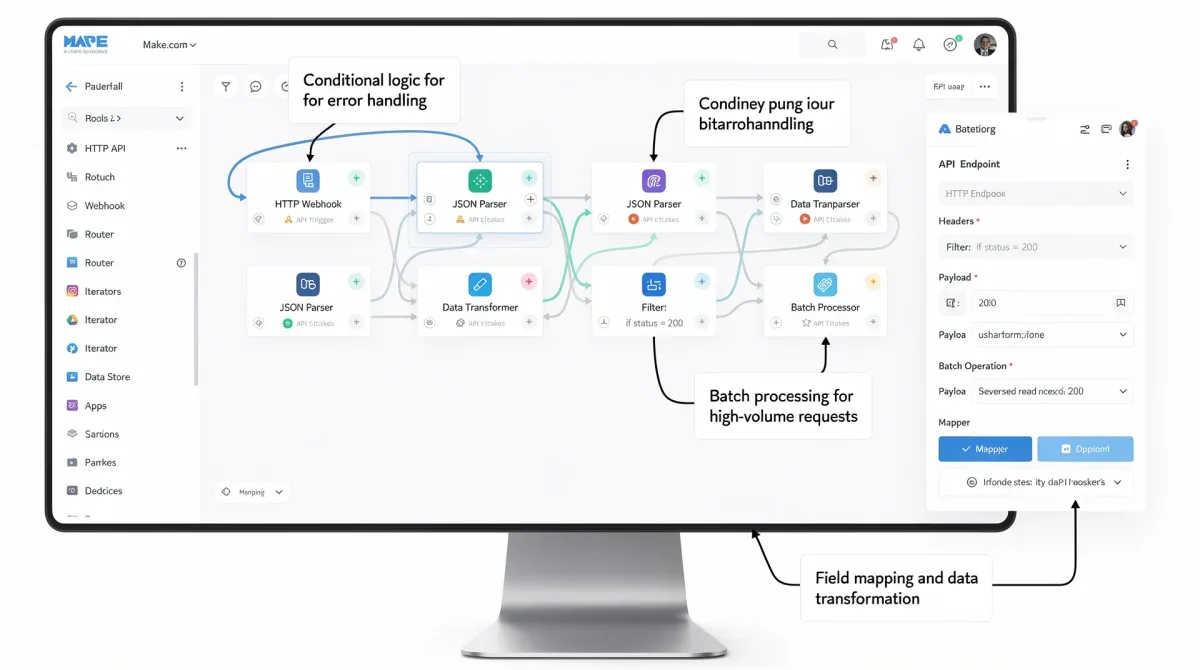
Make.com provides several built-in features that, when utilized correctly, can significantly reduce API consumption. Understanding and implementing these features is crucial for achieving cost savings. The platform's visual builder makes it easy to add conditional logic and error handling, which are key to preventing unnecessary API calls.
- Filters and Routers: These modules allow you to define conditions under which subsequent modules (and thus API calls) are executed. For example, only proceeding with an API call if a specific data point meets certain criteria.
- Data Stores: Make.com's data stores can be used to cache frequently accessed data, reducing the need to make repetitive API calls to external services. This is particularly useful for configuration data or reference lists that don't change often.
- Iterators and Aggregators: These modules help in processing collections of items. Iterators can split a single API response containing multiple items into individual bundles, while aggregators can combine multiple bundles into a single one before making an API call, thus enabling batch processing if the target API supports it.
- Error Handling: Robust error handling allows scenarios to gracefully recover from temporary API issues without endlessly retrying or failing, which can prevent unnecessary API call spikes.
While Make.com offers powerful tools for optimization, its pricing model is primarily based on the number of operations (API calls) and data transfer. This means that every module executed in a scenario counts as an operation. Therefore, careful planning and continuous monitoring are essential. Users should regularly review their scenario histories to identify any inefficiencies or redundant operations that could be costing them money. Leveraging Make.com's scheduling options to run scenarios at optimal times can also contribute to cost management, especially for APIs with different pricing tiers based on time of day.
In summary, Make.com offers a robust platform for automation with significant potential for API cost optimization. Its visual nature provides clarity, but effective cost reduction hinges on intelligent workflow design, leveraging its filtering, caching, and batching capabilities, and consistently monitoring operational metrics to fine-tune scenarios.
n8n: Open-Source Flexibility and Cost Control
n8n positions itself as a powerful workflow automation tool that offers unparalleled flexibility, primarily due to its open-source nature and the option for self-hosting. Unlike fully managed cloud platforms, n8n provides users with a choice: utilize their cloud service or deploy it on their own infrastructure. This fundamental difference has profound implications for API consumption costs, offering a level of control that can lead to significant savings, potentially exceeding 50% for high-volume users.
The core advantage of n8n's self-hosted model is the ability to run workflows on your own servers, meaning you control the execution environment and resource allocation. This eliminates per-operation fees that are common with managed services. While there are infrastructure costs associated with self-hosting (servers, maintenance, scaling), these can often be more predictable and scalable than transaction-based pricing, especially when existing infrastructure can be leveraged.
How n8n Reduces API Costs
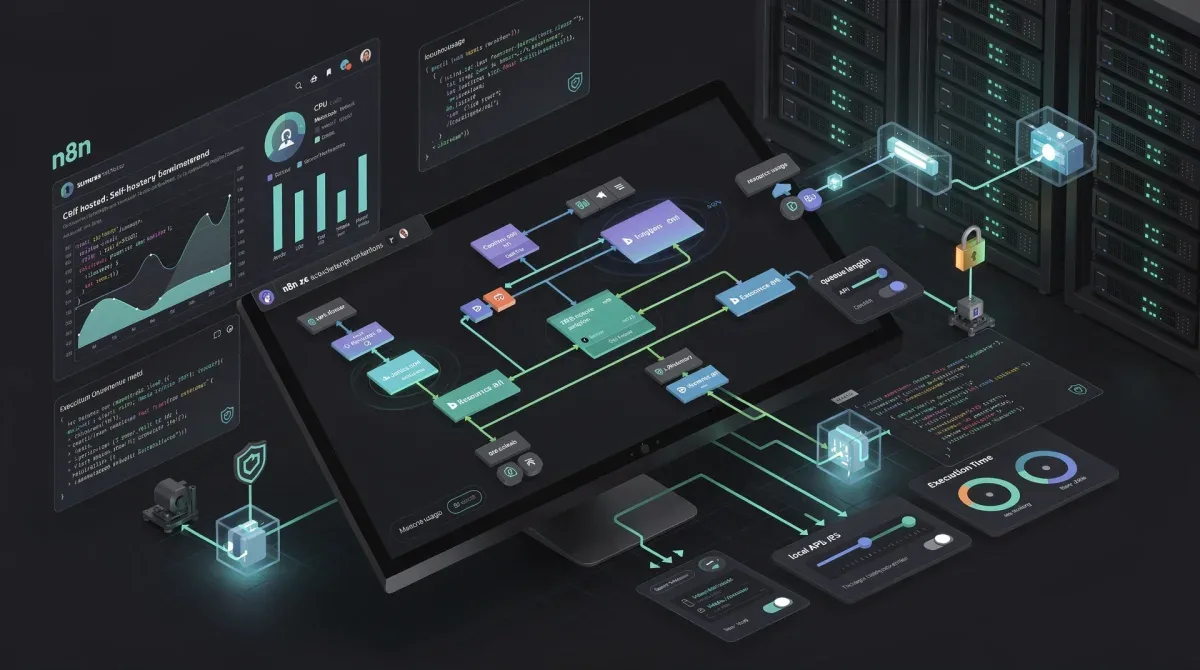
n8n's architecture and operational model contribute to API cost reduction in several key ways. The freedom to self-host means that the number of operations or API calls within your workflows does not directly translate into per-execution charges from n8n itself. Your costs are primarily tied to your infrastructure and the external APIs you consume, rather than the automation platform's operational fees.

- Self-Hosting: By running n8n on your own servers, you pay for the computing resources (CPU, RAM, storage, bandwidth) rather than per-operation fees. This allows for greater control over scaling and resource utilization, which can be more cost-effective for high-volume scenarios.
- Custom Nodes and Logic: n8n's open-source nature allows developers to create custom nodes and implement highly specific logic. This means you can tailor API interactions precisely, minimizing redundant calls and optimizing data processing before engaging external APIs.
- Local Data Processing: Workflows can perform extensive data manipulation and filtering on your local server before making external API calls. This reduces the amount of data transferred and the number of calls to external services, especially if only a subset of data is needed.
- Advanced Caching: With self-hosting, you have the flexibility to implement advanced caching strategies at the infrastructure level, further reducing the need for repetitive API calls to external services.
While n8n offers significant cost advantages, it's important to acknowledge the trade-offs. Self-hosting requires technical expertise for setup, maintenance, and scaling. Users must manage updates, ensure security, and monitor server performance. However, for organizations with existing IT infrastructure and a desire for maximum control, n8n presents a compelling case for dramatic API cost reduction. Its flexible pricing model, where you primarily pay for your own server resources, can lead to substantial savings compared to per-operation models, especially as automation scales.
In conclusion, n8n's open-source and self-hosted capabilities offer a powerful pathway to reducing API consumption costs. By taking control of the execution environment and leveraging customizability, businesses can design and run highly efficient workflows that minimize external API interactions and optimize resource usage, potentially achieving significant savings.
Comparing Pricing Models: Make.com vs n8n
When considering Make.com vs n8n for API cost reduction, a deep dive into their respective pricing models is absolutely essential. These models dictate not only the direct costs but also influence how you design and optimize your workflows. Understanding these differences is key to identifying which platform offers the best value for your specific use case and budget. Both platforms aim to provide powerful automation, but their financial structures cater to different operational philosophies.
Make.com operates on a subscription-based model, primarily charging based on the number of 'operations' executed within your scenarios and the volume of data transferred. An 'operation' typically corresponds to a module's execution within a workflow. This model is straightforward and predictable for users with consistent, moderate automation needs. However, for highly active workflows or those with unpredictable spikes in usage, costs can escalate rapidly, making careful monitoring a necessity.
Make.com's Operation-Based Pricing
Make.com's pricing tiers are structured around a set number of operations and data transfer limits per month. As you scale your automation, you move to higher tiers with more operations and features. This model is ideal for businesses that prefer a fully managed service without the overhead of infrastructure management. The simplicity of getting started and the robust support are significant advantages.
- Tiered Plans: Various plans (e.g., Free, Core, Pro, Teams, Enterprise) offer different operation limits, data transfer, and features.
- Scalability: Easy to upgrade plans as automation needs grow, providing seamless scaling without manual server adjustments.
- Cost Predictability (within limits): For consistent workloads, costs are predictable as long as operations stay within the chosen plan's limits.
- Overages: Exceeding plan limits often incurs additional per-operation charges, which can quickly add up if not managed.
In contrast, n8n offers a more flexible pricing structure. While they do have a cloud-hosted version with operation-based pricing similar to Make.com, their primary differentiator is the open-source, self-hosted option. This allows users to deploy n8n on their own servers, shifting the cost burden from per-operation fees to infrastructure expenses. This model is particularly attractive for organizations with existing cloud infrastructure, robust IT teams, or those requiring strict data sovereignty.
n8n's Self-Hosted Cost Advantage
For organizations opting for n8n's self-hosted version, the cost model fundamentally changes. Instead of paying n8n for each operation, you pay for the infrastructure (e.g., AWS, Google Cloud, Azure, or on-premise servers) required to run n8n. This can lead to substantial savings, especially for high-volume automation, as the incremental cost of additional operations often approaches zero once the infrastructure is in place.
The self-hosted model requires an initial investment in setup and ongoing maintenance, including server management, security updates, and monitoring. However, for a business already managing its own cloud infrastructure, these additional tasks can be integrated into existing operations. The cost benefits become particularly pronounced when an organization's API consumption is high, as the fixed cost of infrastructure can be amortized across a vast number of operations, making the effective cost per operation significantly lower than a managed service.
Ultimately, the choice between Make.com's operation-based pricing and n8n's flexible self-hosted model boils down to a balance of convenience, control, and expected usage. Make.com offers ease of use and a fully managed experience, while n8n provides maximum flexibility and potentially much lower operational costs for those willing to manage their own infrastructure. For companies aiming to cut API consumption costs by over 50%, n8n's self-hosted option presents a compelling argument due to its ability to decouple automation costs from per-operation fees.
Real-World Scenarios: Achieving Over 50% Cost Reduction
The promise of cutting API consumption costs by over 50% is ambitious, but entirely achievable under the right circumstances, particularly when leveraging the strengths of n8n's self-hosted model or meticulously optimizing Make.com workflows. Let's explore real-world scenarios where such significant savings can be realized, highlighting the strategic decisions and technical implementations that drive these reductions.
Consider a medium-sized e-commerce business that relies heavily on automation for inventory management, customer support, and order processing. Their existing setup uses a cloud-based automation platform with per-operation pricing. With thousands of orders daily, each triggering multiple API calls for inventory updates, shipping label generation, and customer notifications, their monthly API costs are soaring. This scenario is ripe for significant cost reduction.
Case Study: E-commerce and High-Volume Integrations
In an e-commerce context, a typical order fulfillment workflow might involve: checking inventory (API call 1), updating inventory (API call 2), creating a shipping label (API call 3), sending a customer notification (API call 4), and updating a CRM (API call 5). If this process runs for 5,000 orders a day, that's 25,000 API calls daily just for one workflow, totaling 750,000 calls per month. With a managed service charging even a modest $0.001 per operation, this quickly amounts to $750 per month, not including data transfer or other workflows.
Scenario 1: Optimizing with Make.com
Using Make.com, the e-commerce business could implement several optimizations. First, they could use filters to ensure that API calls are only made when absolutely necessary (e.g., only send a customer notification if the order status changes to 'shipped'). Second, they could leverage Make.com's aggregators to batch multiple inventory updates or customer notifications into single API calls if the target APIs support it. Third, by using Make.com's data stores, frequently accessed product information could be cached locally within Make.com, reducing repeated calls to the product database API. These optimizations, while effective, still operate within Make.com's operation-based pricing model, meaning careful design is crucial to stay within plan limits and avoid overage charges.
Scenario 2: Transitioning to n8n Self-Hosted
For the same e-commerce business, transitioning to n8n's self-hosted model offers a more radical path to cost reduction. By deploying n8n on their existing AWS infrastructure, they essentially internalize the operational costs. Instead of paying per API call to the automation platform, they pay for the underlying server resources. If they already have underutilized server capacity, the incremental cost of running n8n could be minimal. Furthermore, with n8n's customizability, they could develop specific nodes to pre-process data locally, reducing the payload and frequency of external API calls. They could also implement sophisticated caching at the server level, further cutting down on redundant API interactions.
For a business with 750,000 monthly operations, the infrastructure cost for a dedicated n8n instance might be around $50-$100 per month on a cloud provider, plus labor for maintenance. This represents a potential saving of over 80% compared to the $750 monthly cost from a managed service. The initial setup and ongoing management require technical expertise, but the long-term savings for high-volume users are undeniable.
These real-world examples illustrate that achieving over 50% cost reduction in API consumption is not a fantasy. It requires a strategic choice of automation platform, deep understanding of its features, and a commitment to optimizing workflows. While Make.com offers powerful tools for efficiency, n8n's self-hosted model often provides the most significant leverage for dramatic cost savings, especially for organizations with high API call volumes and the technical capacity to manage their own infrastructure.
Key Factors for Choosing the Right Tool
Selecting the ideal automation tool between Make.com and n8n involves a careful evaluation of several critical factors beyond just immediate API consumption costs. While the potential for over 50% savings is a strong motivator, a holistic approach considering technical capabilities, scalability, maintenance, and team expertise will ensure the chosen platform aligns with long-term business objectives. Both tools offer distinct advantages that cater to different organizational needs and resources.
One of the primary considerations is the level of technical expertise available within your team. Make.com is designed for ease of use, enabling non-developers and citizen integrators to build complex workflows with minimal coding knowledge. Its visual interface and extensive pre-built integrations lower the barrier to entry significantly. In contrast, n8n, particularly its self-hosted version, often requires a more technical team for deployment, maintenance, and advanced customization, appealing more to developers and technically proficient users.
Scalability and Performance Requirements
The anticipated scale of your automation workflows and performance demands are crucial decision points. For projects with moderate volumes and predictable usage patterns, Make.com's managed service offers reliable performance and easy scalability without requiring users to manage servers. You simply upgrade your plan as your needs grow, and Make.com handles the underlying infrastructure.
- Make.com: Excellent for rapid deployment and scaling without infrastructure headaches. Best for businesses prioritizing speed and ease of management over granular control of execution environment.
- n8n: Offers ultimate control over scaling and performance when self-hosted. Ideal for high-throughput, mission-critical workflows where custom optimization and resource allocation are paramount. Requires robust DevOps practices.
Another vital factor is the desire for data sovereignty and security. For organizations with strict compliance requirements or a need to keep sensitive data within their own network, n8n's self-hosted option provides unparalleled control. Data never leaves your infrastructure unless explicitly configured to interact with external APIs. Make.com, as a cloud-based service, processes data on its servers, although it adheres to stringent security protocols and compliance standards. The choice here depends heavily on your organization's specific regulatory and security mandates.
Finally, consider the total cost of ownership (TCO). While n8n's self-hosted version can lead to lower direct API operation costs, it introduces indirect costs related to infrastructure, maintenance, and the technical personnel required to manage it. Make.com's TCO includes subscription fees but offloads infrastructure management and support. A comprehensive TCO analysis, factoring in both direct and indirect expenses over time, is essential for an informed decision.
In conclusion, choosing between Make.com and n8n is not a one-size-fits-all decision. Factors such as team technical expertise, scalability needs, data governance, and a thorough total cost of ownership analysis should guide your choice. Both platforms are powerful, but their optimal use cases diverge significantly based on these underlying organizational considerations.
Maximizing Savings: Best Practices for Both Platforms
Regardless of whether you choose Make.com or n8n, implementing best practices in workflow design and management is paramount to maximizing savings and truly cutting API consumption costs, potentially by over 50%. The tools themselves provide the capabilities, but it's how you wield them that determines the ultimate efficiency and cost-effectiveness of your automation strategy. A proactive and analytical approach is key to unlocking the full potential of either platform.
One universal best practice is the principle of 'less is more' when it comes to API calls. Every call has a cost, whether direct or indirect. Therefore, thoroughly analyze each step of your workflow to identify and eliminate any unnecessary or redundant API interactions. This often involves careful data filtering, local processing, and strategic caching to minimize external dependencies. Thinking critically about when and why an API call is made is the first step towards optimization.
Common Optimization Strategies
Several strategies apply broadly to both Make.com and n8n, helping to reduce API consumption and improve overall workflow efficiency. Adopting these practices from the outset can prevent costly rework and ensure your automation scales economically.
- Conditional Execution: Use filters and conditional logic to ensure API calls are only made when specific criteria are met. Avoid executing modules or nodes if their output is not essential for the current path.
- Batch Processing: Whenever possible, group multiple related operations into a single API call. Many APIs support batch endpoints that can process several requests in one go, significantly reducing the number of individual calls.
- Data Caching: Implement caching for frequently accessed, static, or slow-changing data. Instead of hitting an API every time, store the data locally (in a database, file, or platform-specific data store) and refresh it periodically.
- Error Handling and Retries: Design robust error handling. Instead of immediate retries, implement exponential backoff strategies for transient errors to avoid hammering an API and consuming quotas unnecessarily. Log errors effectively to identify persistent issues.
- Efficient Data Mapping: Only send and receive the data truly needed. Avoid over-fetching data from APIs or sending large payloads when only a few fields are required. Optimize data structures to be lean and efficient.
For Make.com users, regularly reviewing your scenario history and operation logs is crucial. These insights help identify scenarios that are consuming more operations than expected or exhibiting inefficient patterns. Make use of the platform's built-in monitoring tools and alerts to stay on top of usage and costs. For n8n users, especially those self-hosting, monitoring server resources (CPU, memory, network I/O) and implementing robust logging are vital. Custom dashboards can provide a holistic view of workflow performance and API consumption.
Furthermore, regardless of the platform, always stay updated with the latest features and best practices. Both Make.com and n8n are constantly evolving, introducing new functionalities that can enhance efficiency and offer new ways to optimize API usage. Engaging with their respective communities can also provide valuable insights and solutions to common challenges.
In conclusion, maximizing savings on API consumption with either Make.com or n8n is an ongoing process that demands attention to detail and a commitment to optimization. By consistently applying best practices such as conditional execution, batch processing, caching, and diligent monitoring, businesses can significantly reduce their operational costs and ensure their automation efforts are both powerful and economical.
| Key Aspect | Description |
|---|---|
| Pricing Model | Make.com uses operation-based pricing; n8n offers self-hosted flexibility with infrastructure costs. |
| Cost Reduction Potential | n8n self-hosted can achieve over 50% savings for high-volume users due to no per-operation fees. |
| Ease of Use | Make.com is more user-friendly for non-technical users; n8n requires more technical expertise for self-hosting. |
| Control & Customization | n8n offers superior control and customization, ideal for specific optimization needs and data sovereignty. |
Frequently Asked Questions
What is the primary difference in cost structure between Make.com and n8n?▼Make.com charges primarily based on operations (API calls) and data transfer within tiered plans. n8n, especially its self-hosted version, shifts costs from per-operation fees to infrastructure expenses, allowing for greater control over operational costs for high-volume usage.
Can Make.com help reduce API consumption costs significantly?▼Yes, Make.com can reduce costs through efficient workflow design, using filters, aggregators, and data stores to minimize redundant calls. However, its operation-based pricing means careful optimization is needed to avoid exceeding plan limits and incurring overage charges.
How does n8n's self-hosting option contribute to cost savings?▼Self-hosting n8n allows users to run workflows on their own servers, paying for computing resources instead of per-operation fees. This can lead to substantial savings for high-volume automation, as the incremental cost per operation becomes much lower than managed services.
What technical expertise is required for n8n's self-hosted setup?▼Deploying and maintaining a self-hosted n8n instance typically requires technical expertise in server management, cloud infrastructure, and potentially some development skills for custom nodes. This is a key consideration compared to Make.com's fully managed service.
What are the best practices for maximizing API cost savings on any automation platform?▼Key practices include using conditional execution, implementing batch processing, caching data, and designing robust error handling with intelligent retry mechanisms. Regularly monitoring workflow performance and API usage also helps identify and address inefficiencies.
Conclusion
The decision between Make.com and n8n for optimizing API consumption costs hinges on a nuanced understanding of your organization's specific needs, technical capabilities, and financial priorities. While Make.com offers an accessible, visually driven platform perfect for rapid deployment and ease of management, its operation-based pricing model necessitates meticulous workflow design to keep costs in check. Conversely, n8n, particularly through its self-hosted option, presents a compelling pathway to dramatic cost reductions, potentially exceeding 50% for high-volume users, by shifting operational expenses from per-call fees to infrastructure management. This flexibility, however, comes with the prerequisite of technical expertise for deployment and maintenance. Ultimately, both platforms are powerful tools, but the truly significant savings are realized when the chosen tool aligns perfectly with your operational context and is complemented by diligent best practices in workflow optimization.
