Dolby Atmos vs. DTS:X: Superior Home Theater Audio in 2026
Choosing between Dolby Atmos and DTS:X for superior home theater immersion in 2026 depends on content availability, equipment compatibility, and personal preference, as both offer object-based, three-dimensional soundscapes.
Are you ready to elevate your home entertainment experience to cinematic heights? The perennial debate of Dolby Atmos vs. DTS:X: Which Audio Format Delivers Superior Home Theater Immersion in 2026? continues to captivate enthusiasts seeking the ultimate audio fidelity for their living spaces. As technology evolves, understanding the nuances of these cutting-edge sound technologies becomes crucial for making an informed decision that truly transforms your home theater.
Understanding immersive audio: The core principles
Immersive audio formats like Dolby Atmos and DTS:X represent a significant leap beyond traditional surround sound. Instead of channel-based audio, where sounds are mixed to specific speakers (e.g., left front, right rear), these technologies utilize object-based audio. This means individual sounds, or 'audio objects,' are encoded with metadata that defines their position in a three-dimensional space, independent of speaker layout. Your AV receiver then dynamically renders these objects to the available speakers in your setup, creating a truly enveloping sound field that includes overhead effects.
This paradigm shift allows for a much more dynamic and realistic sound experience. Imagine a helicopter flying overhead: with object-based audio, the sound can be precisely placed and moved through your room, rather than simply being played through a 'rear surround' channel. The goal is to blur the lines between reality and reproduction, placing you squarely in the center of the action. Both Dolby Atmos and DTS:X achieve this through sophisticated algorithms and the ability to leverage a greater number of speakers, including those mounted on the ceiling or firing upwards to reflect sound off the ceiling.

The core principle of immersive audio is creating a sound bubble around the listener. This is achieved by adding a vertical dimension to the soundstage, something traditional 5.1 or 7.1 systems cannot replicate. By treating individual sounds as objects, the audio mixer has far greater control over their placement and movement, leading to a more natural and believable auditory experience. This flexibility also means the audio can adapt to various speaker configurations, from modest setups to elaborate multi-speaker arrays, without losing the intended immersive effect.
Dolby Atmos: The pioneer of object-based sound
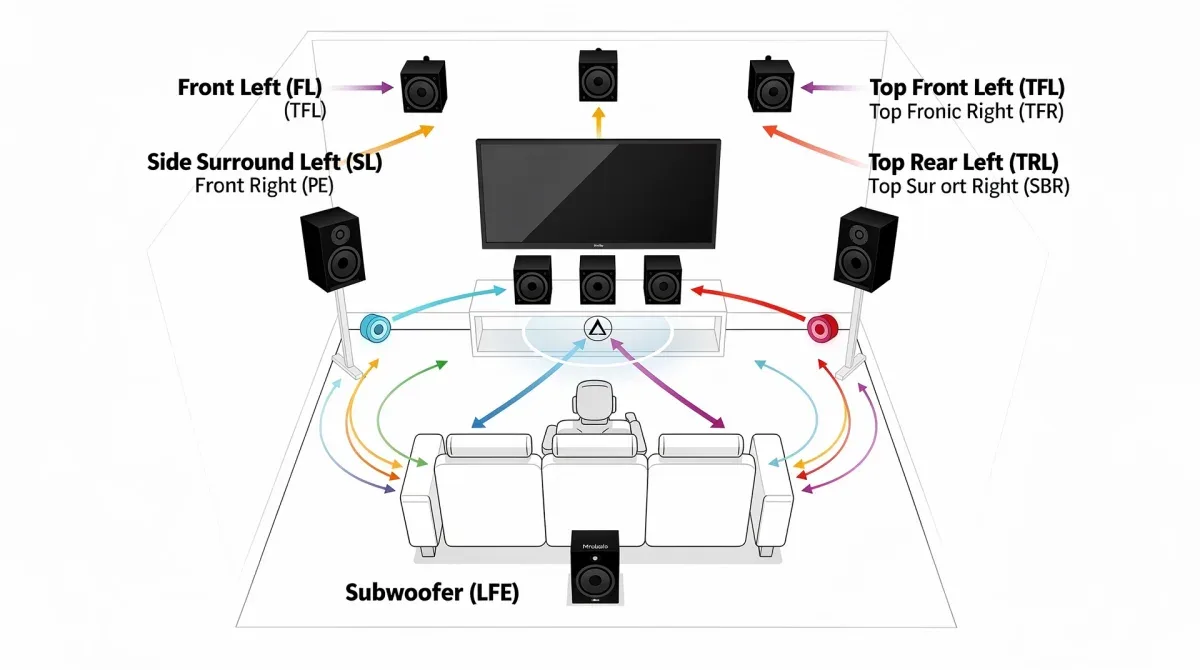
Dolby Atmos burst onto the scene in 2012, initially in commercial cinemas, before making its way into home theaters. It quickly established itself as the leading immersive audio format, largely due to its early adoption by major studios and streaming platforms. Atmos builds upon traditional surround sound layouts by adding height channels, typically either ceiling-mounted speakers or "Atmos-enabled" speakers that bounce sound off the ceiling. This creates a dome of sound that truly envelops the listener, making effects like rain, helicopters, or soaring birds feel incredibly realistic.
The technology behind Dolby Atmos allows for up to 128 audio objects within a scene, each with its own spatial coordinates. This metadata-driven approach enables precise placement and movement of sounds, regardless of the specific speaker configuration. From a modest 5.1.2 setup (five traditional speakers, one subwoofer, two height speakers) to a more elaborate 7.1.4 or even 9.1.6 system, Atmos scales intelligently to deliver the best possible immersive experience tailored to your hardware. Its widespread support across content, hardware, and streaming services has solidified its position in the market.
Key characteristics of Dolby Atmos
Dolby Atmos offers several distinct advantages that have contributed to its widespread adoption and reputation:
- Extensive Content Library: A vast array of movies, TV shows, and even music is available in Dolby Atmos, especially on popular streaming platforms like Netflix, Disney+, Apple TV+, and Max.
- Scalable Speaker Configurations: Atmos supports a wide range of speaker setups, from basic soundbars with up-firing drivers to complex multi-speaker systems with dedicated height channels.
- Early Market Adoption: Its head start in both cinematic and home theater spaces has given it a significant lead in terms of hardware and content compatibility.
Dolby Atmos's ability to create a truly three-dimensional soundstage, combined with its robust ecosystem, makes it a compelling choice for anyone looking to build a premium home theater. The seamless integration with existing Dolby technologies also ensures a smooth upgrade path for many users. The emphasis on precise object placement provides a level of detail and realism that was previously unattainable in consumer audio.
DTS:X: The flexible alternative
DTS:X arrived a few years after Dolby Atmos, offering its own take on object-based immersive audio. While also utilizing audio objects, DTS:X distinguishes itself with a focus on flexibility regarding speaker placement. Unlike Atmos, which often specifies ceiling or up-firing speakers for height effects, DTS:X aims to be more adaptable to existing speaker layouts, allowing users greater freedom in their room configuration. It can remap sound objects to fit whatever speaker arrangement you have, often without requiring dedicated height channels, although they are certainly supported for enhanced immersion.
The underlying technology of DTS:X, much like Atmos, processes individual audio objects and renders them dynamically to your speaker system. This means that a sound object's position isn't tied to a specific channel but rather to a point in 3D space. The DTS:X decoder in your AV receiver then calculates the optimal way to reproduce that sound using your available speakers. This "channel-agnostic" approach is a key selling point for those who prefer not to install in-ceiling speakers or use up-firing modules.
DTS:X also supports a feature called "dialog control," which allows users to adjust the volume of dialogue independently from the rest of the soundtrack. This can be a significant benefit for those who struggle to hear dialogue clearly during action sequences or complex mixes. While its content library might not be as extensive as Dolby Atmos, DTS:X is widely supported on Blu-ray and 4K UHD discs, and an increasing number of streaming services are beginning to offer DTS:X content. Its adaptability and unique features make it a strong contender in the immersive audio landscape.
DTS:X advantages and features
DTS:X brings its own set of compelling features to the home theater experience:
- Speaker Layout Flexibility: Less restrictive about speaker placement, potentially making it easier to integrate into existing home theater setups without major modifications.
- Dialogue Control: Unique ability to adjust dialogue volume independently, a valuable feature for clarity in complex soundtracks.
- Robust Blu-ray Support: Often found on physical media, appealing to enthusiasts who prefer disc-based content for uncompressed audio quality.
The focus on flexibility means that DTS:X can often provide a compelling immersive experience even in rooms where ideal speaker placement is challenging. This user-centric approach, combined with features like dialogue control, makes DTS:X a very attractive option for a broad range of home theater owners. Its commitment to high-fidelity audio on physical media also ensures that disc collectors have access to premium sound.
Content availability and ecosystem support in 2026
When considering Dolby Atmos vs. DTS:X, the availability of content is paramount. In 2026, Dolby Atmos continues to hold a significant lead in terms of widespread content support. Major streaming platforms such as Netflix, Disney+, Max, Apple TV+, and Amazon Prime Video offer a vast library of movies and TV shows mixed in Dolby Atmos. This ubiquitous presence means that most users with compatible equipment will frequently encounter Atmos content. Furthermore, many video games on current-generation consoles (PlayStation 5, Xbox Series X/S) also support Dolby Atmos, extending its reach beyond film and television.
DTS:X, while growing, still lags behind in streaming service integration. Its primary stronghold remains physical media, particularly 4K UHD Blu-ray discs. Many reference-quality movie releases on disc feature DTS:X (or its higher-bandwidth variant, DTS:X Pro), offering uncompressed, high-fidelity audio that often surpasses streaming quality. However, for the average consumer who primarily streams content, finding DTS:X encoded material can be more challenging. Some services are beginning to experiment with DTS:X, but it's not as universally adopted as Atmos.
The ecosystem of supported hardware also plays a crucial role. Most modern AV receivers, soundbars, and even some smart TVs released in 2026 support both Dolby Atmos and DTS:X. This dual compatibility means that choosing one format over the other often isn't a mutually exclusive decision regarding hardware. However, the sheer volume of content available for Atmos often makes it the more frequently utilized format for many users. The ongoing competition between these two formats continues to drive innovation, benefiting consumers with increasingly sophisticated audio experiences.
Hardware compatibility and setup considerations
Setting up an immersive audio system requires careful consideration of hardware and speaker placement. For both Dolby Atmos vs. DTS:X, you will need an AV receiver (or a compatible soundbar) that explicitly supports the desired format. Most mid-range to high-end AV receivers manufactured in recent years are capable of decoding both Atmos and DTS:X. The key difference often lies in the number of channels supported (e.g., 7.1.2, 7.1.4, 9.1.6), which dictates how many height speakers you can incorporate.
For Dolby Atmos, dedicated height speakers are generally recommended for the most impactful experience. These can be in-ceiling speakers, on-ceiling speakers, or up-firing modules that reflect sound off your ceiling. The exact placement and angle are crucial for achieving the intended overhead effects. Dolby provides specific guidelines for speaker placement to optimize the Atmos sound field. While soundbars with up-firing drivers can provide a taste of Atmos, a discrete multi-speaker setup will always deliver superior immersion and sound separation.
DTS:X, with its greater flexibility, can often deliver immersive sound using a more traditional 5.1 or 7.1 speaker layout, though adding height speakers will undoubtedly enhance the experience. Its ability to remap audio objects means it can adapt to less-than-ideal speaker placements more gracefully than Atmos. However, for optimal performance with either format, careful calibration of your system using the receiver's auto-calibration features (like Audyssey, Dirac Live, or YPAO) is essential. Room acoustics also play a significant role; treating your room with acoustic panels can further improve clarity and immersion, regardless of the audio format you choose.
Performance and subjective listening experience
When it comes to the actual listening experience, the differences between Dolby Atmos vs. DTS:X can be subtle and often subjective. Both formats are designed to create a three-dimensional sound field, placing you within the action. Many audiophiles and home theater enthusiasts find Dolby Atmos to offer a slightly more precise and distinct placement of overhead effects, particularly when dedicated ceiling speakers are used. This can lead to a very convincing sense of objects moving directly above and around you, contributing to a truly enveloping experience.
DTS:X, on the other hand, is often praised for its dynamic range and a perceived "fullness" to the sound, especially in its DTS:X Pro iteration. Some listeners describe DTS:X as having a more aggressive or impactful bass response and a broader soundstage. Its flexibility in speaker placement can also mean that, even in less-than-ideal room configurations, it can still deliver a very satisfying immersive effect. The dialogue control feature in DTS:X is a practical advantage for many, allowing for clearer conversations without needing to constantly adjust overall volume.
Ultimately, the "superior" format often comes down to the specific content being played, the quality of your audio equipment, and individual preferences. A well-mixed Dolby Atmos track on a high-end system can be breathtaking, just as a superb DTS:X track can be equally impressive. It's not uncommon for dedicated home theater enthusiasts to have systems capable of decoding both, allowing them to enjoy the best of both worlds depending on the content. The continuous advancements in both technologies mean that the gap in overall performance is narrowing, making both excellent choices for immersive audio.
The future of immersive audio in 2026 and beyond
As we look ahead to the future of immersive audio in 2026 and beyond, both Dolby Atmos and DTS:X are poised for continued evolution. The trend towards higher channel counts and more sophisticated sound rendering is likely to continue. Dolby is exploring advancements in personalized audio, where sound experiences can be tailored to individual listeners, possibly through headphones or even smart home devices. This could lead to immersive audio experiences that are less dependent on a traditional multi-speaker home theater setup, making it more accessible to a wider audience.
DTS, with its acquisition by Xperi, is also pushing the boundaries of immersive sound. DTS:X Pro, already offering support for up to 32 discrete channels, demonstrates their commitment to high-fidelity, high-channel-count audio. They are also focusing on integrating immersive audio into more mainstream devices and platforms, potentially expanding their footprint in areas like automotive audio and mobile devices. The competition between these two giants will undoubtedly drive further innovation, leading to even more realistic and captivating soundscapes.
Another significant development is the increasing integration of immersive audio into music. While initially focused on movies, both formats are seeing a rise in music releases mixed for spatial audio. This offers a completely new way to experience music, with instruments and vocals placed in a three-dimensional space around the listener. As more artists and labels embrace spatial audio, this could become a major growth area for both Dolby Atmos and DTS:X, transforming how we consume and appreciate music in our homes. The future promises a truly enveloping auditory experience across all forms of media.
| Key Feature | Description |
|---|---|
| Object-Based Audio | Both formats utilize individual sound objects mapped in 3D space for dynamic rendering. |
| Content Availability | Dolby Atmos has broader streaming support; DTS:X is prevalent on 4K UHD Blu-ray discs. |
| Speaker Flexibility | DTS:X offers more flexibility in speaker placement; Atmos often recommends dedicated height channels. |
| Dialogue Control | DTS:X uniquely offers independent dialogue volume adjustment, enhancing clarity. |
Frequently asked questions about immersive audio
Do I need special speakers for Dolby Atmos or DTS:X?▼For optimal immersion, dedicated height speakers are recommended for both formats. For Dolby Atmos, these are typically in-ceiling, on-ceiling, or up-firing speakers. DTS:X is more flexible, potentially working with existing layouts, but benefits greatly from height channels too. A compatible AV receiver is essential for decoding either format.
Can my current AV receiver support both Dolby Atmos and DTS:X?▼Most modern AV receivers, especially those from the mid-range to high-end, released in recent years (and certainly by 2026), support both Dolby Atmos and DTS:X. Check your receiver's specifications or manual to confirm its compatibility and the number of channels it supports for immersive audio.
Which format has more content available for streaming?▼In 2026, Dolby Atmos generally has a more extensive library of content available on major streaming platforms like Netflix, Disney+, and Max. While DTS:X content is growing, particularly on 4K UHD Blu-ray, its streaming presence is not as widespread as Dolby Atmos.
Is there a noticeable sound quality difference between Atmos and DTS:X?▼The perceived sound quality differences are often subjective and depend heavily on the specific audio mix, equipment, and room acoustics. Some listeners find Atmos offers more precise overhead effects, while DTS:X is sometimes described as having a fuller soundstage and more dynamic bass. Both deliver excellent immersive experiences.
Do I have to choose only one format for my home theater?▼No, most modern AV receivers are designed to decode both Dolby Atmos and DTS:X. This means you don't have to choose one over the other. Your system will automatically play the appropriate immersive audio format based on the content you are watching, allowing you to enjoy both.
Conclusion
The choice between Dolby Atmos vs. DTS:X: Which Audio Format Delivers Superior Home Theater Immersion in 2026? isn't about one format being definitively "better" than the other in all aspects. Both represent the pinnacle of immersive audio technology, offering object-based sound that transcends traditional channel limitations. Dolby Atmos benefits from widespread content availability across streaming platforms and its precise spatial rendering with dedicated height channels. DTS:X counters with greater speaker placement flexibility, robust support on physical media, and unique features like dialogue control. Ultimately, the superior format for your home theater in 2026 will depend on your primary content sources, your existing or planned speaker setup, and your personal auditory preferences. The good news is that most modern equipment supports both, allowing you to experience the best of both worlds and truly immerse yourself in cinematic soundscapes.
