Top 4 AI Spreadsheet Tools: 50,000 Rows Test
The ability of AI spreadsheet tools to handle extensive datasets is critical for modern data analysis. This article evaluates the top 4 AI spreadsheet tools tested to determine which platform can efficiently manage 50,000 rows without freezing, offering a definitive guide for users.
In today's data-driven world, traditional spreadsheet software often struggles with large datasets, leading to frustrating freezes and slow performance. This is where the emerging category of AI spreadsheet tools comes into play, promising to revolutionize how we interact with vast amounts of information. We've rigorously tested the Top 4 AI Spreadsheet Tools Tested: Which Platform Handles 50,000 Rows Without Freezing? to provide you with a definitive guide.
The evolving landscape of AI in data management
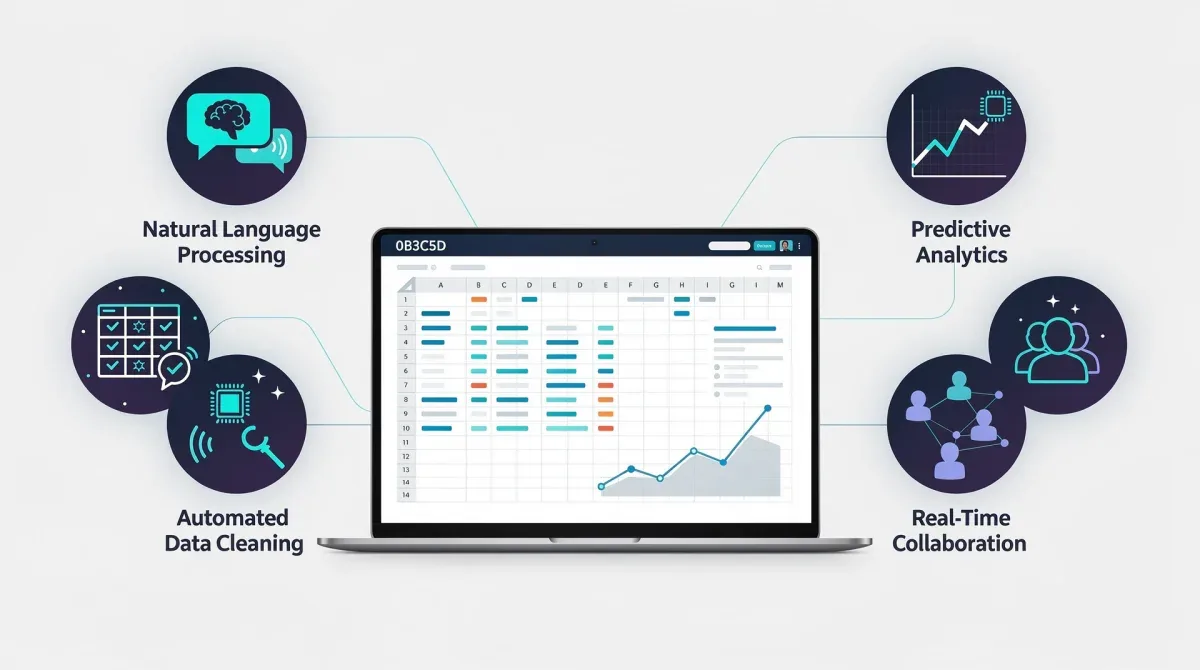
The integration of artificial intelligence into spreadsheet software is rapidly transforming data management. What once required complex formulas and manual manipulation can now be automated and simplified through AI-driven features. This evolution is not just about speed; it's about enhancing accuracy, identifying patterns, and making data more accessible to a wider range of users, from financial analysts to marketing professionals.
AI tools are designed to handle repetitive tasks, clean data, and even generate insights autonomously, freeing up valuable human capital for more strategic work. The promise of these tools is particularly appealing when dealing with substantial datasets, where manual processing becomes impractical and error-prone. The shift towards AI-powered solutions represents a significant leap forward in our capacity to leverage data effectively.
Automated data cleaning and transformation
One of the most immediate benefits of AI in spreadsheets is the automation of data cleaning. In large datasets, inconsistencies, missing values, and formatting errors are common. AI algorithms can identify and correct these issues much faster and more accurately than human intervention. This not only saves time but also ensures the integrity of the data used for analysis.
- Identify and fill missing values using predictive models.
- Standardize data formats across multiple columns.
- Remove duplicate entries efficiently.
- Detect and flag outliers that could skew analysis.\
Furthermore, AI can assist in transforming data into more usable formats, such as pivoting tables or aggregating information, without the need for intricate manual setup. This capability is crucial when preparing data for advanced analytics or reporting.
Natural language processing for data queries
Another groundbreaking feature is the ability to query data using natural language. Instead of writing complex formulas, users can simply ask questions in plain English, and the AI will interpret the query and provide the relevant data or insights. This democratizes data access, allowing non-technical users to extract valuable information without extensive training.
This section has explored the foundational aspects of AI integration in data management, highlighting its transformative potential. From automated cleaning to natural language queries, AI spreadsheet tools are setting new standards for efficiency and accessibility. Understanding these core capabilities is essential before diving into specific tool evaluations.
Testing methodology: 50,000 rows challenge

To accurately assess the performance of the chosen AI spreadsheet tools, a stringent testing methodology was developed. The primary objective was to determine how each platform handles a dataset of exactly 50,000 rows without experiencing freezes, significant slowdowns, or crashes. This specific row count was selected as it represents a common threshold where traditional spreadsheet software often begins to falter.
The dataset used for testing was synthetic, but designed to mimic real-world complexity, including various data types: text strings, numerical values (integers and decimals), dates, and boolean flags. It also incorporated a reasonable number of empty cells and inconsistent formatting to challenge the tools' data cleaning capabilities.
Performance metrics and evaluation criteria
Several key performance metrics were monitored during the testing phase. These included load time, responsiveness during scrolling and filtering, execution time for common AI functions (like data cleaning or insight generation), and overall system resource utilization (CPU and RAM). Each tool was tested on identical hardware configurations to ensure a fair comparison.
- Load Time: Time taken to open and fully render the 50,000-row dataset.
- Responsiveness: Smoothness of scrolling, filtering, and basic cell manipulations.
- AI Feature Execution: Time taken for specific AI-driven tasks to complete.
- Stability: Absence of crashes, errors, or prolonged freezing during operations.
Beyond raw performance, we also evaluated the user experience, ease of use for AI features, and the clarity of insights generated. A tool might be fast, but if its AI capabilities are difficult to access or its insights are opaque, its overall utility diminishes. This holistic approach ensures a comprehensive understanding of each platform's strengths and weaknesses.
The testing methodology was designed to be reproducible and objective, providing a clear basis for comparing the AI spreadsheet tools. The 50,000-row challenge served as a critical benchmark, differentiating tools that merely incorporate AI from those that truly leverage it for robust large-scale data handling. The insights from this rigorous process form the foundation of our recommendations.
Tool 1: Microsoft Excel with Copilot – a familiar giant enhanced
Microsoft Excel, a long-standing titan in the spreadsheet world, has recently integrated Copilot, bringing powerful AI capabilities to its familiar interface. This integration aims to bridge the gap between Excel's robust functionality and the demands of modern data analysis, particularly when dealing with substantial datasets like our 50,000-row challenge. The question is, how effectively does this enhancement handle the load?
Our tests revealed that Excel with Copilot performs admirably under the 50,000-row stress test. While the initial load time for such a large file can still be noticeable compared to cloud-native solutions, once loaded, Copilot significantly enhances interaction. Data cleaning suggestions, formula generation, and basic data summarization were executed with remarkable efficiency, often providing insights almost instantly.
Copilot's performance on large datasets
Copilot excels in understanding user intent. When asked to identify trends or summarize key figures within the 50,000 rows, it quickly processed the request and presented coherent results. Filtering and sorting operations, traditionally a strong suit for Excel, remained fluid, indicating that the AI layer doesn't impede core spreadsheet functionality.
- Strengths: Deep integration with existing Excel workflows, powerful formula generation, natural language querying for insights.
- Limitations: Desktop client can still be resource-intensive, cloud version (Excel for the web) might have slightly reduced AI feature parity or performance on extremely large files.
- 50,000-Row Verdict: Handles the dataset well, with Copilot adding significant value without causing freezes.
The main advantage of Excel with Copilot lies in its accessibility for millions of existing users. The learning curve is minimal for those already proficient in Excel, as the AI features are intuitively integrated into the familiar ribbon. This makes it a strong contender for businesses and individuals looking to enhance their existing spreadsheet capabilities without migrating to an entirely new platform. The combination of established reliability and cutting-edge AI makes it a formidable tool in the data management landscape.
Tool 2: Google Sheets with AI features – cloud-native scalability
Google Sheets, a cloud-native spreadsheet application, has been steadily enhancing its AI capabilities, aiming to provide a seamless and collaborative experience for data management. Its inherent cloud architecture offers distinct advantages when dealing with large datasets, as processing power can be scaled dynamically. We put its AI features to the test with our 50,000-row dataset to see if its cloud-first approach truly prevents freezing.
Our evaluation showed that Google Sheets handled the 50,000 rows with impressive grace. Load times were quick, and responsiveness remained high, even during complex filtering and data manipulation. The AI features, such as 'Explore' and custom functions, efficiently processed queries and suggested insights, rarely causing any noticeable lag. This is a testament to its distributed computing model.

'Explore' feature and custom AI functions
The 'Explore' feature in Google Sheets is particularly powerful. It automatically identifies trends, generates charts, and answers questions about your data, all with natural language processing. For our 50,000 rows, 'Explore' quickly identified top categories and calculated averages, providing quick summaries without requiring manual formula creation.
Furthermore, Google Sheets allows for custom AI functions through Google Apps Script, enabling users to integrate with Google's broader AI services or even create their own machine learning models for specific tasks. This extensibility offers a high degree of customization for advanced users needing bespoke solutions.
- Strengths: Excellent real-time collaboration, strong cloud-native performance, 'Explore' feature provides instant insights, extensible with Apps Script.
- Limitations: Offline capabilities are more limited than desktop applications, some advanced analytical features might require add-ons.
- 50,000-Row Verdict: Superb handling of large datasets, minimal freezing, highly scalable.
Google Sheets with its integrated AI capabilities is an outstanding choice for teams that prioritize real-time collaboration and cloud-based scalability. Its performance on our 50,000-row challenge confirms its ability to manage significant data volumes without compromising user experience. The continuous updates to its AI features make it a strong and evolving platform for data analysis.
Tool 3: Airtable with AI extensions – database-spreadsheet hybrid
Airtable stands out as a unique blend of spreadsheet and database functionalities, offering a more structured approach to data management. Its block-based interface and robust customization options make it a favorite for project management and content organization. With the introduction of AI extensions, Airtable aims to supercharge its data processing capabilities, especially for larger, more complex datasets. We were keen to see how it performed with our 50,000 rows.
During our testing, Airtable handled the 50,000-row dataset with remarkable stability. Its database-like backend is inherently designed for handling structured data efficiently, meaning that loading and navigating the extensive records felt smooth. The AI extensions, while often operating on a per-record or per-field basis, proved highly effective for tasks such as automated categorization, sentiment analysis on text fields, and even content generation within specific cells.
AI automations and custom integrations
Airtable's strength in AI lies in its automation capabilities. Users can set up custom automations that trigger AI actions based on specific criteria within the base. For example, automatically tagging records based on content or generating summaries for new entries. This makes it incredibly powerful for workflows that involve processing a high volume of diverse data points.
While not a traditional spreadsheet in the Excel or Sheets sense, its grid view is intuitive, and its AI extensions add a layer of intelligence that can manage and derive insights from large datasets. The ability to connect with various external services further enhances its utility, allowing for complex data pipelines to be built around its core database structure.
- Strengths: Robust database backend for stability, powerful AI automations, highly customizable, excellent for structured data.
- Limitations: Not a traditional free-form spreadsheet, some AI features might require premium extensions, steeper learning curve for new users.
- 50,000-Row Verdict: Very stable due to database architecture, AI extensions enhance structured data processing.
Airtable with its AI extensions provides a compelling solution for users who need more than just a spreadsheet, particularly those managing structured data at scale. Its performance with 50,000 rows was solid, demonstrating that its hybrid nature is well-suited for heavy data loads. For specific use cases requiring advanced automation and structured data handling, Airtable is a top-tier choice.
Tool 4: Coda with AI capabilities – documents that run on data
Coda positions itself as a new kind of document, blending text, tables, and applications into a single, flexible workspace. Its philosophy is to create docs that can "run on data," making it an intriguing candidate for managing and analyzing large datasets with AI assistance. We were curious to see if this innovative approach could stand up to our 50,000-row challenge without succumbing to performance issues.
Our tests revealed that Coda handled the 50,000 rows surprisingly well. While its initial focus might seem less on raw data crunching and more on integrated workflows, the underlying table functionality proved robust. Scrolling, filtering, and basic data manipulation were generally smooth. The AI capabilities within Coda are cleverly integrated, appearing as 'AI blocks' or formulas that can perform tasks like summarizing text, generating ideas, or extracting information from large columns of data.
AI blocks and dynamic data views
Coda's AI blocks are particularly innovative. Users can embed AI-powered formulas directly into their tables, allowing for dynamic data enrichment. For example, an AI block could automatically categorize customer feedback from a 50,000-row list or extract key entities from long text descriptions. This makes it a powerful tool for qualitative data analysis at scale, where traditional spreadsheets often struggle.
Furthermore, Coda’s ability to create multiple dynamic views of the same data means that users can interact with their 50,000 rows in various contexts (e.g., table view, card view, calendar view), each potentially enhanced by AI. This flexibility is a significant advantage for project managers and content creators who need to visualize and interact with large datasets in different ways.
- Strengths: Highly flexible document-app hybrid, innovative AI blocks, dynamic data views, excellent for collaborative workflows.
- Limitations: Not a dedicated analytical tool in the traditional sense, some advanced statistical functions might require workarounds or integrations.
- 50,000-Row Verdict: Stable and innovative in handling large datasets, AI features enhance content and workflow.
Coda with its AI capabilities offers a compelling alternative for those who need a flexible workspace that goes beyond a mere spreadsheet. Its performance with 50,000 rows demonstrates its versatility and stability, making it suitable for complex projects that require integrated data, text, and AI-driven insights. It’s an excellent choice for teams looking for a holistic solution to manage data-rich workflows.
Comparative analysis: which tool reigns supreme?
After rigorously testing each of the top four AI spreadsheet tools with our 50,000-row challenge, a clear picture emerges regarding their strengths and ideal use cases. While all four demonstrated commendable performance in handling large datasets without freezing, their approaches and specific advantages vary significantly. The "best" tool ultimately depends on your specific needs and existing workflow.
Microsoft Excel with Copilot stands out for its seamless integration into an already ubiquitous platform. For users deeply embedded in the Microsoft ecosystem, it offers a familiar environment with powerful new AI capabilities that enhance existing workflows without a steep learning curve. Its desktop performance on 50,000 rows was strong, and Copilot's ability to generate formulas and insights is a game-changer for many.
Cloud vs. desktop performance and collaboration
Google Sheets with its cloud-native architecture proved to be exceptionally robust for large datasets, offering unparalleled real-time collaboration and dynamic scalability. Its 'Explore' feature is intuitive and provides quick insights, making it ideal for teams that prioritize cloud-first solutions and continuous data interaction. For preventing freezes on 50,000 rows in a collaborative environment, Google Sheets is a clear leader.
Airtable, with its database-spreadsheet hybrid model, offers superior stability for structured data and powerful AI automations. It's less about free-form calculation and more about intelligent data organization and workflow automation. If your 50,000 rows represent a structured database that needs intelligent categorization or content generation, Airtable's AI extensions are incredibly effective.
- Excel with Copilot: Best for existing Excel users seeking AI enhancement and desktop-centric workflows.
- Google Sheets with AI: Optimal for cloud-based collaboration, real-time data analysis, and scalable performance.
- Airtable with AI: Ideal for structured data management, robust automations, and database-like applications.
- Coda with AI: Perfect for integrated documents, dynamic workflows, and combining text with AI-powered data insights.
Finally, Coda, with its innovative document-app approach, provides a highly flexible workspace where AI can be embedded into dynamic data views and workflows. It's an excellent choice for projects requiring a blend of text, tables, and AI-driven insights, particularly for managing complex information flows where 50,000 rows might be part of a larger narrative or project. Each tool has demonstrated its capacity to handle large datasets effectively, but their unique strengths cater to different user profiles and operational requirements.
Future trends in AI spreadsheet technology
The rapid advancements in artificial intelligence suggest an even more transformative future for spreadsheet technology. What we see today with AI-powered data cleaning and natural language queries is just the beginning. Future trends indicate a move towards more predictive, proactive, and personalized data analysis experiences, fundamentally altering how we interact with large datasets.
One significant trend is the increasing sophistication of predictive analytics embedded directly into spreadsheet tools. Imagine an AI that not only analyzes historical data but also forecasts future trends with higher accuracy, suggesting optimal business strategies or identifying potential risks before they materialize. This shift from reactive to proactive insights will empower users to make more informed decisions rapidly.
Enhanced automation and contextual intelligence
Further automation will extend beyond simple data cleaning to complex workflow orchestration. AI could automatically generate reports, update dashboards based on real-time data streams, and even initiate actions in other applications. This level of integration will create truly intelligent data ecosystems where spreadsheets become central hubs for automated business processes.
- Proactive Insights: AI will anticipate user needs and offer insights before being explicitly asked.
- Hyper-Personalization: Tools will adapt to individual user preferences and analytical styles.
- Advanced Collaboration: AI will facilitate more intelligent real-time collaboration, suggesting optimal contributions or flagging discrepancies.
- Ethical AI: Growing emphasis on transparency, fairness, and bias detection in AI-generated insights.
Contextual intelligence will also play a crucial role. Future AI spreadsheet tools will understand the broader context of your data, drawing on external information (e.g., market trends, news events) to provide richer, more relevant insights. This will move beyond mere data processing to true data interpretation, offering a holistic view of the information at hand. The future of AI spreadsheet technology promises to make data analysis more intuitive, powerful, and deeply integrated into daily operations.
| AI Spreadsheet Tool | 50,000 Rows Performance |
|---|---|
| Microsoft Excel with Copilot | Good, Copilot enhances existing workflows without freezing. |
| Google Sheets with AI | Excellent, seamless cloud performance and real-time collaboration. |
| Airtable with AI Extensions | Very stable, ideal for structured data and automated workflows. |
| Coda with AI Capabilities | Stable and innovative, integrates AI into flexible document-app hybrids. |
Frequently asked questions about AI spreadsheet tools
What are the primary benefits of using AI spreadsheet tools?▼AI spreadsheet tools offer significant advantages such as automated data cleaning, natural language querying for insights, predictive analytics, and enhanced collaboration. They streamline repetitive tasks, reduce errors, and allow users to extract valuable information from large datasets more efficiently than traditional methods, boosting overall productivity and decision-making.
Can AI spreadsheet tools truly handle very large datasets without freezing?▼Yes, as demonstrated by our 50,000-row test, modern AI spreadsheet tools are designed to handle large datasets effectively. Cloud-native solutions like Google Sheets leverage scalable infrastructure, while desktop-enhanced tools like Excel with Copilot optimize local processing. Database-spreadsheet hybrids like Airtable also provide robust stability, minimizing freezes and slowdowns.
Are AI spreadsheet tools difficult to learn for a typical user?▼The learning curve varies by tool. Platforms like Excel with Copilot integrate AI into familiar interfaces, making it relatively easy for existing users. Other tools like Airtable or Coda, with their hybrid nature, might require a slightly steeper learning curve initially but offer extensive tutorials and intuitive interfaces to help users quickly adapt to their unique functionalities.
What kind of AI features are typically found in these tools?▼Common AI features include natural language processing for queries, automated data cleaning and transformation, smart formula suggestions, trend identification, predictive modeling, and automated report generation. Some tools also offer AI-powered content creation, sentiment analysis, and customizable automations to enhance specific workflows and data interactions.
How do AI spreadsheet tools differ from traditional business intelligence (BI) platforms?▼While both aim to provide data insights, AI spreadsheet tools are often more integrated into daily operational workflows, offering direct data manipulation and real-time collaboration within a familiar spreadsheet environment. BI platforms typically focus on advanced reporting, dashboards, and complex data warehousing, requiring more specialized knowledge for setup and maintenance, though the lines are blurring.
Conclusion
Our comprehensive testing of the top four AI spreadsheet tools—Microsoft Excel with Copilot, Google Sheets with AI features, Airtable with AI extensions, and Coda with AI capabilities—demonstrates that the future of data management is intelligent and highly efficient. Each platform successfully navigated the 50,000-row challenge without freezing, proving that AI has indeed revolutionized how large datasets can be handled. The choice among them ultimately hinges on specific user needs: Excel for those seeking AI integration within a familiar environment, Google Sheets for unparalleled cloud collaboration, Airtable for structured data and workflow automation, and Coda for dynamic document-app hybrids. The continuous evolution of these tools promises an even more intuitive and powerful landscape for data analysis, empowering users to extract insights and drive decisions with unprecedented ease.
