PCIe 5.0 SSDs: Why 14,000 MB/s Speeds Boost Content Creators
PCIe 5.0 SSDs deliver unprecedented data transfer speeds of up to 14,000 MB/s, fundamentally transforming workflows for content creators by drastically reducing load times, accelerating rendering, and enabling seamless handling of massive files.
The world of digital content creation demands speed, efficiency, and unwavering performance from its hardware. For professionals in video editing, 3D rendering, game development, and high-resolution photography, storage is no longer just a place to keep files; it’s a critical component directly impacting productivity and creative flow. This is where the Solid-State Drive (SSD) Guide: Why PCIe 5.0 Speeds of 14,000 MB/s Matter for Content Creators becomes indispensable, revealing how this cutting-edge technology is not just an upgrade, but a revolution for demanding workflows.
Understanding the leap to PCIe 5.0 NVMe SSDs
The evolution of storage technology has been relentless, pushing boundaries to meet the ever-growing demands of digital data. PCIe 5.0 NVMe SSDs represent the latest significant leap, offering speeds that were once unimaginable. This new standard doubles the bandwidth of its predecessor, PCIe 4.0, fundamentally reshaping what's possible in high-performance computing.
For content creators, understanding this transition is crucial. It's not merely about bigger numbers; it's about unlocking new levels of efficiency and capability in their daily tasks. The theoretical maximum throughput of PCIe 5.0 can reach up to 32 GT/s per lane, translating into a staggering 14,000 MB/s or even more for consumer-grade SSDs, with enterprise solutions pushing even higher. This raw speed impacts everything from application load times to complex file transfers.
The technical foundation of PCIe generations
Each generation of Peripheral Component Interconnect Express (PCIe) effectively doubles the bandwidth of the previous one. This exponential growth is achieved through advancements in signaling technology and increased data transfer rates per lane. PCIe 5.0, for instance, utilizes 16 lanes (x16) to deliver its peak performance, making it ideal for devices that require massive data throughput.
- Increased Bandwidth: PCIe 5.0 offers 32 GT/s per lane, doubling PCIe 4.0's 16 GT/s.
- Enhanced Efficiency: Improved encoding schemes contribute to more effective data transfer.
- Backward Compatibility: PCIe 5.0 slots are backward compatible with older generation devices, though they will operate at the slower standard's speed.
The shift to PCIe 5.0 is driven by the increasing data intensity of modern applications and workloads. From artificial intelligence and machine learning to ultra-high-definition video production, the demand for faster access to vast datasets is constant. This technological advancement ensures that storage devices can keep pace with processors and graphics cards, preventing bottlenecks that can cripple productivity.
In conclusion, PCIe 5.0 NVMe SSDs are not just a minor iteration but a major architectural improvement designed to handle the most intensive data operations. Their underlying technical capabilities lay the groundwork for a new era of performance, especially for professionals who rely on rapid data access and processing in their creative endeavors.

The 14,000 MB/s advantage for video editing
For video editors, time is money, and waiting for files to load or renders to complete can significantly impact project deadlines and creative flow. The advent of PCIe 5.0 SSDs, boasting speeds up to 14,000 MB/s, offers a transformative advantage that directly addresses these pain points. This incredible throughput fundamentally alters the experience of working with high-resolution footage.
Imagine editing 8K or even 12K RAW video files directly from your storage, with virtually no latency or stutter. This is the promise of PCIe 5.0. Traditional storage solutions, even older NVMe drives, can struggle with the immense data rates required for such demanding formats, leading to dropped frames, proxies, and a less fluid editing experience. With 14,000 MB/s, editors can scrub through timelines, apply complex effects, and export projects with unprecedented speed.
Accelerating RAW footage workflows
Working with uncompressed or lightly compressed RAW video files requires a storage system capable of sustaining incredibly high read and write speeds. These files can easily consume hundreds of megabytes per second, and when multiple streams are involved, the demands escalate rapidly.
- Instantaneous Previews: Real-time playback of multiple 4K/8K streams without dropped frames.
- Faster Ingest: Quicker transfer of large video files from external media to the workstation.
- Reduced Export Times: Significantly shorter rendering and export durations for final projects.
The ability to handle these massive datasets with such agility means less time waiting and more time creating. Editors can experiment more freely, iterate faster, and deliver projects on tighter schedules. This improved responsiveness not only boosts productivity but also enhances the overall creative process, allowing for more complex and ambitious projects without the frustration of hardware limitations.
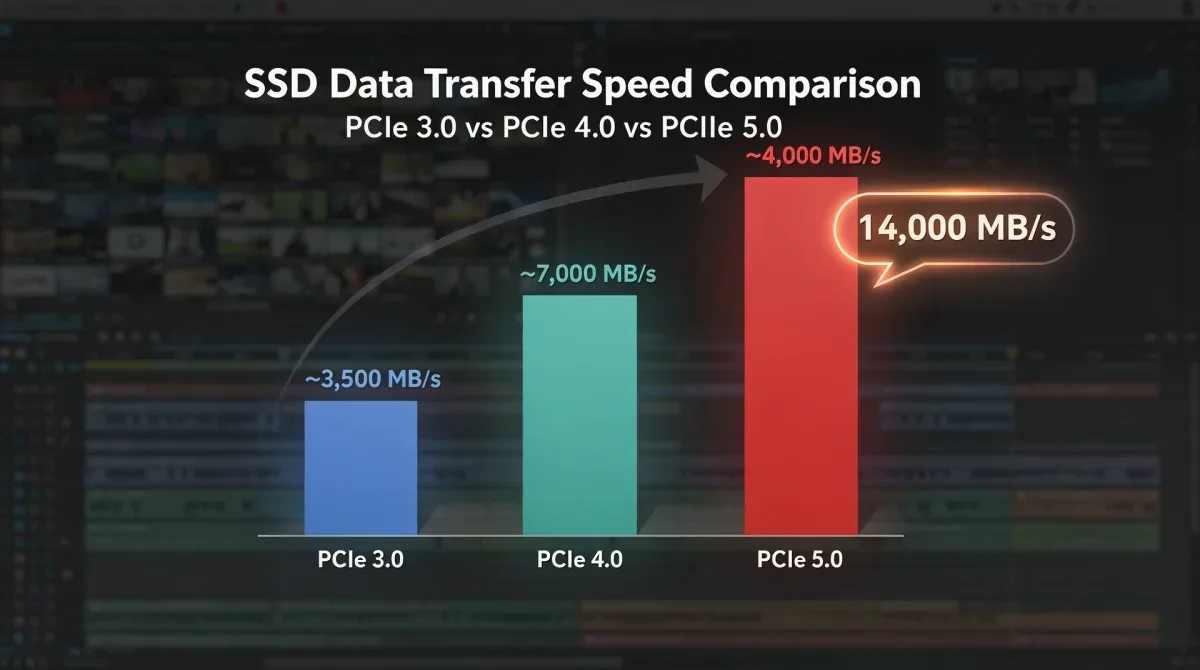
In essence, PCIe 5.0 SSDs provide the necessary bandwidth to keep pace with the increasing resolution and complexity of modern video production. The 14,000 MB/s speed isn't just a benchmark; it's a practical tool that empowers video editors to push their creative boundaries without being held back by storage bottlenecks, making the entire workflow smoother and more efficient.
Boosting 3D rendering and animation performance
3D rendering and animation are among the most computationally intensive tasks a workstation can undertake. These processes involve loading vast textures, complex models, and intricate scene data, often from storage. The speed of data access directly impacts render times, viewport responsiveness, and the overall efficiency of the creative pipeline. PCIe 5.0 SSDs, with their 14,000 MB/s transfer rates, offer a substantial performance uplift for these demanding workloads.
When artists are working on large-scale environments or highly detailed character models, the ability to quickly load assets into memory is critical. Traditional storage can cause significant delays, leading to frustrating waiting times before rendering even begins. PCIe 5.0 drives minimize these bottlenecks, allowing artists to iterate faster and focus more on the creative aspects rather than technical hindrances.
Optimizing asset loading and scene compilation
Many 3D applications rely on rapid access to a multitude of small and large files—textures, geometry, animations, and simulation caches. The aggregate speed at which these assets can be read and written heavily influences performance.
- Faster Scene Loading: Complex 3D scenes with millions of polygons and high-resolution textures load almost instantly.
- Quick Texture Streaming: High-resolution textures are streamed rapidly, improving viewport performance and reducing pop-in.
- Accelerated Cache Management: Simulation caches for physics, fluids, and cloth can be written and read much faster, speeding up iterations.
Beyond initial loading, the 14,000 MB/s speed also significantly benefits tasks like baking textures, compiling shaders, and processing large data sets for simulations. These operations often involve repeated reads and writes to storage, where the sheer throughput of PCIe 5.0 can shave hours off production schedules. The rapid data flow ensures that the CPU and GPU are consistently fed with the information they need, preventing idle cycles and maximizing the utilization of expensive hardware.
In conclusion, for 3D artists and animators, PCIe 5.0 SSDs are not just a luxury but a necessity for maintaining a competitive edge. The immense speed of 14,000 MB/s transforms resource-intensive tasks, making workflows more fluid and allowing artists to dedicate more time to their craft, ultimately leading to higher quality and more efficient output.
Seamless large file transfer and project management
Content creators frequently deal with massive file sizes, whether it's uncompressed video footage, intricate 3D models, high-resolution photographic archives, or game development assets. The efficient transfer and management of these large files are paramount to maintaining productivity and streamlining project workflows. PCIe 5.0 SSDs, with their exceptional speeds of up to 14,000 MB/s, dramatically improve these operations, making what was once a time-consuming chore a near-instantaneous process.
Moving terabytes of data between drives, backing up projects, or sharing files across a network (when paired with sufficiently fast networking hardware) becomes significantly less burdensome. The bottleneck often lies in the storage medium itself, and with PCIe 5.0, that bottleneck is largely eliminated, allowing data to flow at speeds that truly match the demands of modern content creation.
Streamlining collaborative workflows
In collaborative environments, multiple creators often need to access and modify the same large project files. Fast storage is crucial for preventing delays and ensuring everyone has quick access to the latest versions. While network speed plays a role, the local storage read/write speed is fundamental.
- Rapid Project Archiving: Backing up entire projects or archiving completed work is significantly faster.
- Efficient Data Syncing: Synchronizing large datasets with cloud storage or network-attached storage (NAS) becomes more efficient.
- Accelerated Asset Sharing: Sharing vast asset libraries with team members is expedited, reducing setup times for new projects.
Beyond raw transfer speeds, the enhanced performance of PCIe 5.0 SSDs also contributes to a more responsive operating system and faster application launches. This overall system snappiness translates into less downtime and a more pleasant user experience throughout the workday. Content creators can spend more time focused on their work and less time waiting for their system to catch up.
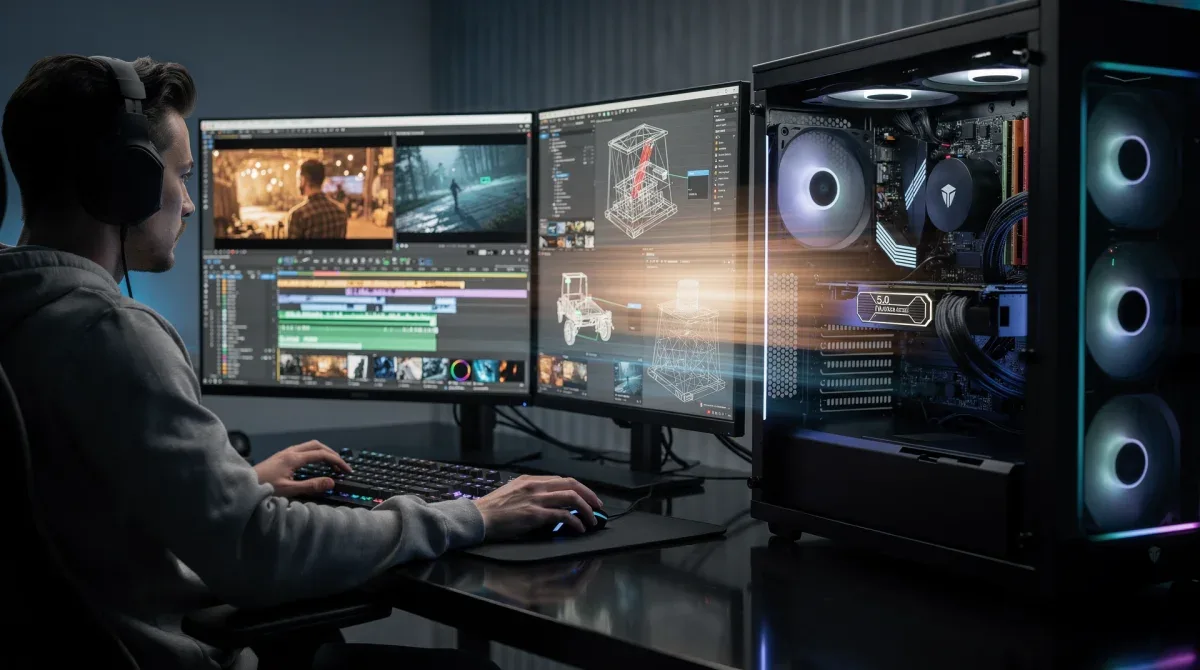
In conclusion, the 14,000 MB/s speeds of PCIe 5.0 SSDs are a game-changer for large file transfers and overall project management. They enable content creators to handle vast amounts of data with ease, foster more efficient collaborative workflows, and ultimately contribute to a more productive and less frustrating creative process. This level of performance ensures that data movement is no longer a bottleneck but an enabler of creativity.
Gaming development and virtual reality content
The realms of game development and virtual reality (VR) content creation are inherently demanding, requiring immense computational power and lightning-fast data access. Developing immersive worlds, intricate character models, and complex game mechanics involves constant loading, saving, and compiling of large assets. PCIe 5.0 SSDs, with their staggering 14,000 MB/s speeds, offer a significant advantage, directly impacting efficiency and the quality of the final product.
For game developers, the ability to quickly load game engines, compile code, and test builds can drastically cut down iteration times. In VR, where every millisecond of latency can break immersion, fast storage ensures that high-resolution textures and complex environments are streamed seamlessly, preventing stutters and maintaining a fluid user experience during development and testing.
Revolutionizing asset streaming and build times
Modern games and VR experiences rely heavily on asset streaming, where textures, models, and audio are loaded dynamically as the player moves through the environment. This technique requires an extremely fast storage solution to avoid pop-in or loading hitches.
- Faster Game Engine Loading: Development environments like Unreal Engine or Unity load significantly quicker.
- Reduced Build Times: Compiling large game builds and updates takes less time, accelerating the development cycle.
- Seamless VR Asset Streaming: Ensures high-fidelity VR environments load and render without noticeable delays, crucial for immersion.
Furthermore, the rapid I/O capabilities of PCIe 5.0 SSDs are also beneficial for tasks such as shader compilation, texture baking, and large-scale data processing that are common in game development. These operations often involve reading and writing massive amounts of temporary data, and the increased bandwidth ensures that these processes are completed as quickly as possible, freeing up developers to focus on creative tasks.
In conclusion, for game developers and VR content creators, the 14,000 MB/s speeds of PCIe 5.0 SSDs are not just about raw performance; they are about enabling more agile development cycles, facilitating higher fidelity experiences, and ultimately pushing the boundaries of what's possible in interactive digital content. This technology is a cornerstone for creating the next generation of games and virtual worlds.
Future-proofing your workstation with PCIe 5.0
Investing in new technology is not just about addressing current needs; it’s also about preparing for the demands of tomorrow. For content creators, future-proofing a workstation with PCIe 5.0 SSDs is a strategic move that ensures sustained performance and compatibility with upcoming software and hardware advancements. With speeds of 14,000 MB/s, these drives offer a substantial buffer against obsolescence, providing a robust foundation for years to come.
As file sizes continue to grow, resolutions increase, and software becomes more resource-intensive, the need for faster storage will only intensify. By adopting PCIe 5.0 now, creators are positioning themselves at the forefront of technological capability, capable of handling the most demanding projects without needing immediate upgrades.
Considering motherboard and CPU compatibility
To fully leverage the benefits of PCIe 5.0 SSDs, it’s essential to ensure that your motherboard and CPU support the standard. This typically means having a modern platform (e.g., Intel’s 12th Gen or newer, AMD’s Ryzen 7000 series or newer) that includes PCIe 5.0 slots.
- Platform Upgrade: Ensure your CPU and motherboard are PCIe 5.0 compatible for full performance.
- Cooling Solutions: High-speed PCIe 5.0 SSDs generate more heat, necessitating robust heatsinks.
- Software Optimization: Future software will be increasingly optimized to take advantage of these speeds.
Beyond raw speed, the increased bandwidth of PCIe 5.0 also provides more lanes for other high-performance components, such as graphics cards. This means less contention for resources and a more balanced system overall. For content creators who often rely on powerful GPUs for rendering and processing, this holistic approach to system architecture is incredibly beneficial.
In conclusion, integrating PCIe 5.0 SSDs into your workstation is a smart investment in future productivity. The 14,000 MB/s speeds not only deliver immediate benefits but also ensure that your system remains highly capable as content creation evolves. It’s about building a foundation that can adapt to future challenges and continue to empower your creative vision without compromise.
| Key Aspect | Impact for Content Creators |
|---|---|
| PCIe 5.0 Speeds (14,000 MB/s) | Drastically reduces load times for large files and applications, accelerating all stages of content production. |
| Video Editing | Enables smooth 8K+ RAW playback, faster rendering, and quicker project exports, enhancing workflow fluidity. |
| 3D Rendering & Animation | Accelerates scene loading, texture streaming, and cache management, leading to faster iterations and final renders. |
| Future-Proofing | Prepares workstations for upcoming demanding software and higher resolution content, ensuring long-term relevance. |
Frequently asked questions about PCIe 5.0 SSDs
What is the main advantage of PCIe 5.0 SSDs for content creators?▼The primary advantage is the unprecedented data transfer speed, reaching up to 14,000 MB/s. This allows content creators to handle massive files, such as 8K video or large 3D assets, with significantly reduced load times, faster rendering, and smoother real-time editing, dramatically boosting productivity and creative efficiency.
Do I need a new motherboard and CPU to use a PCIe 5.0 SSD?▼Yes, to fully utilize the 14,000 MB/s speeds of a PCIe 5.0 SSD, your system must have a compatible motherboard and CPU. This typically means a modern platform that supports the PCIe 5.0 standard, such as Intel's 12th generation (or newer) or AMD's Ryzen 7000 series (or newer) processors and chipsets.
How does 14,000 MB/s speed impact video editing?▼For video editing, 14,000 MB/s speeds enable seamless playback of multiple high-resolution (e.g., 8K RAW) video streams without dropped frames. It also drastically reduces project load times, accelerates the application of complex effects, and significantly shortens the time required for final project exports, streamlining the entire post-production workflow.
Are PCIe 5.0 SSDs backward compatible with older PCIe slots?▼Yes, PCIe 5.0 SSDs are generally backward compatible with older PCIe slots (e.g., PCIe 4.0 or 3.0). However, when installed in an older slot, the SSD will operate at the maximum speed supported by that slot, meaning you won't achieve the full 14,000 MB/s performance of a native PCIe 5.0 connection.
What cooling considerations are important for PCIe 5.0 SSDs?▼PCIe 5.0 SSDs, due to their higher performance, generate more heat than previous generations. Proper cooling is crucial to prevent thermal throttling, which can reduce performance. Many PCIe 5.0 drives come with robust heatsinks, and motherboards often include M.2 heatsink solutions. Ensuring adequate airflow in your PC case is also recommended.
Conclusion
The arrival of PCIe 5.0 SSDs, with their astonishing speeds of up to 14,000 MB/s, marks a pivotal moment for content creators across all disciplines. From the demanding timelines of 8K video editing and the intricate processes of 3D rendering to the vast asset management in game development, this technology offers more than just faster loading screens; it provides a fundamental shift in how professionals interact with their data. By eliminating bottlenecks and accelerating workflows, PCIe 5.0 empowers creators to realize their visions with unprecedented efficiency and fluidity. Investing in this cutting-edge storage is not just an upgrade; it is a strategic decision to future-proof your creative workstation, ensuring you remain at the forefront of digital innovation and continue to push the boundaries of what’s possible in the ever-evolving landscape of content creation.
